Situation Summary
Estonia remains a low-threat environment globally (rank #115, composite score 13) with no active security crises, but is experiencing elevated hybrid-threat exposure tied to its role as a NATO member and host to critical defense and infrastructure assets. Current focus centers on the ongoing investigation into an August 14–15 arson at Milrem Robotics in Tallinn—now being assessed as potential sabotage—alongside routine planned protest activity in the capital. The security picture is stable but alert, with elevated concern for critical infrastructure vulnerability rather than widespread civil unrest or public violence.
Key Developments
- Tallinn (Lasnamäe)—Milrem Robotics arson investigation escalates (renewed coverage 25 Aug 2026). Authorities are investigating the mid-August fire at the defense contractor's facility as potential premeditated sabotage linked to Russia; at least two suspects have been detained in Latvia and are being remanded into custody in Estonia. This represents sustained official concern about hostile hybrid activity targeting Estonian defense infrastructure.
- Tallinn—National farmers' protest scheduled 25 Aug 2026. Estonia's agricultural organizations have called a nationwide protest action against planned cuts to farm subsidies, centered in Tallinn with potential for traffic disruption. No violence is anticipated, but large-scale demonstrations carry minor risk of localized public-order issues.
- Tallinn—Political tension over education support obligations (25 Aug 2026). Tallinn city authorities are reportedly considering legal action against the Ministry of Education and Research over mandated municipal support for youth without study placement. No security incident reported; administrative friction only.
- Regional infrastructure vulnerability reassessment (25 Aug analysis). Security analysts are highlighting prior damage to undersea infrastructure linking Finland, Estonia, and Sweden—including the Balticconnector pipeline and data cables—as evidence of critical vulnerability to hybrid threats, positioning Estonia's connectivity assets as high-risk targets.
- No discrete violent incidents or major unrest reported (24–25 Aug 2026). Aside from the Milrem investigation and planned protest, no new crimes, civil unrest, or security events have been confirmed within the last 48 hours in Estonia proper.
Highest-Risk Areas
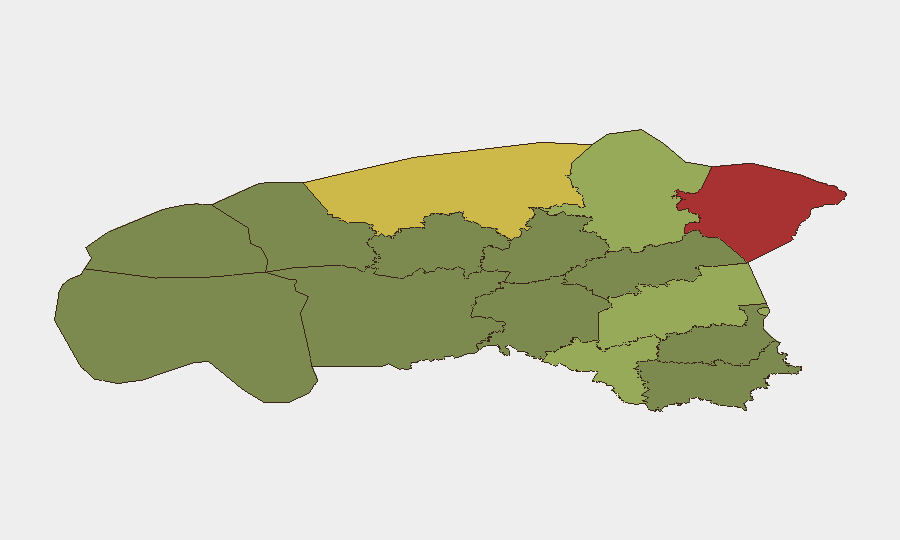
Ida-Viru County (risk 78) and Harju County (risk 68)—which includes Tallinn—drive Estonia's sub-national risk profile. Ida-Viru's elevated score likely reflects its proximity to the Russian border and concentration of energy/industrial infrastructure; Harju's reflects the capital's status as the political, economic, and defense-industry hub, evidenced by the Milrem Robotics facility and sustained focus on critical infrastructure protection. Tartu County (58), Valga County (55), and Lääne-Viru County (52) represent a secondary tier of concern, correlating with border proximity and strategic location. All other counties score substantially lower, indicating risk concentration in the north and east.
How GeoBit Would Assist
Corporate security teams should deploy AOI Monitoring & Early Warning on Tallinn's defense-sector cluster and critical infrastructure sites to detect early indicators of reconnaissance or hostile activity. Intel Sweep and OSINT fusion across regional news, Telegram, and Russian-language sources would provide continuous corroboration of hybrid-threat narratives and any shifts in threat posture. Risk & Threat Assessment tied to travel routing would enable dynamic route avoidance around Tallinn during the 25 August protest window and inform real-time duty-of-care updates for personnel in Harju and Ida-Viru counties.
7-Day Outlook
The 25 August farmers' protest should dissipate without major incident; traffic and access disruptions in central Tallinn are the primary operational concern. The Milrem investigation will likely remain an active news item but is not expected to escalate into broader public-order events. Overall security trajectory remains stable, with hybrid/infrastructure threat as the persistent underlying concern rather than acute civil or criminal risk.
Highest-Risk Areas — Ranked
| # | State / Region | Risk |
|---|---|---|
| 1 | Ida-Viru County | 78 |
| 2 | Harju County | 68 |
| 3 | Tartu County | 58 |
| 4 | Valga County | 55 |
| 5 | Lääne-Viru County | 52 |
| 6 | Pärnu County | 35 |
| 7 | Rapla County | 32 |
| 8 | Jõgeva County | 30 |
| 9 | Järva County | 28 |
| 10 | Viljandi County | 25 |
| 11 | Põlva County | 22 |
| 12 | Võru County | 18 |
Sources
Previous Daily Briefs
A new Estonia brief is written every day — each with its own risk map and downloadable CSV. Here's the last week; use the calendar to go further back.
- August 23, 2026
- August 21, 2026
- August 19, 2026
- August 17, 2026
- August 15, 2026
- August 13, 2026
- August 11, 2026
📅 Browse every day by calendar →
Highlighted days have a brief. Tap a day for that day's map & analysis, or “csv” for that day's dataset ($5).
Atlas — our AI intelligence desk — emails them this snapshot personally. Nothing else, no list.