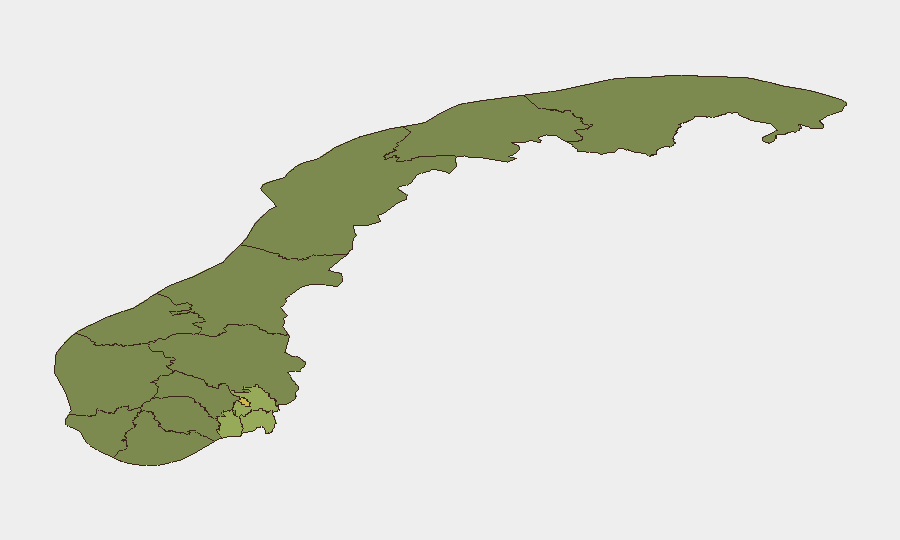
Situation Summary
Norway remains a low-threat environment globally (rank #51, composite score 35) with no tracked active security events at the national level. However, the country is experiencing a convergence of acute stressors: a confirmed large-scale cyberattack on central government digital infrastructure (26 August), significant public gatherings in Oslo following the death of King Harald V (28 August), and sustained labor unrest affecting critical transport. These developments have elevated operational risk in the capital and surrounding regions without fundamentally altering Norway's overall security posture.
Key Developments
- Oslo, Royal Palace area – 28 August: Thousands of civilians gathered in central Oslo to mourn King Harald V and support the transition to King Haakon, creating large, dense crowds that have required enhanced police crowd-management deployment and may continue to affect movement and access in the city center through the state funeral period.
- Nationwide digital infrastructure – 26–29 August (ongoing): Pro-Russian hacker group *Server Killers* launched and claimed responsibility for a large-scale DDoS attack targeting Norway's central government digital infrastructure, affecting up to 10 public services including ID-porten (the national identity and single sign-on gateway) and health-related digital portals. Services were partially or fully restored, but follow-up coverage as of 29 August indicates the incident and its implications remain active topics; attribution by Norwegian authorities remains cautious pending technical analysis.
- Oslo – 26 August (prior 24h context): A 37-year-old Iraqi national fired multiple shots from a moving vehicle in downtown Oslo during daylight hours; armed police responded; no fatalities were reported. The incident reflects an isolated but notable act of violence in the capital and triggered immediate law-enforcement response.
- Oslo Gardermoen Airport – 23 August (prior event, ongoing labor context): Air traffic controller strike resulted in a five-hour complete airport closure (06:30–11:30), canceling or delaying 76 of 346 scheduled operations. Strike began 21 August; labor unrest and potential future disruptions to aviation and transport remain a secondary operational risk.
Highest-Risk Areas
Oslo (risk 68) and surrounding commuter regions—Akershus (52) and Østfold (48)—dominate the risk landscape, driven by population density, critical government and digital infrastructure concentration, and recent incident clustering. The capital's convergence of large public mourning crowds, active cyberattack aftermath, and labor unrest creates a compound operational picture requiring heightened awareness and contingency planning. Rogaland (38), home to major petroleum and offshore industry assets, warrants monitoring given the earlier detection of a suspected espionage incident targeting petroleum transport (21 August, border interdiction); the pro-Russian cyber threat and geopolitical context elevate secondary risks to strategic infrastructure even in lower-risk regions.
How GeoBit Would Assist
Intel Sweep and multi-language search capabilities enable continuous monitoring of Norwegian police, PST (security service), and Digdir announcements, combined with OSINT fusion and X/Twitter OSINT to corroborate emerging incidents and rule out disinformation. AOI Monitoring & Early Warning with persistent alerting on Oslo, Gardermoen, and critical infrastructure zones would provide 24/7 detection of crowd events, transport disruptions, and security incidents. Network & Actor Analysis applied to *Server Killers* and pro-Russian cyber actors, plus sentiment & temporal analysis of labor sentiment, would support predictive signaling of follow-on attacks or strikes.
7-Day Outlook
The near-term trajectory hinges on the state funeral period (timing TBD) and potential persistence of the cyberattack threat. Large public gatherings in Oslo are likely to continue through early September, requiring crowd-management and movement contingency planning. Cyberattack risk and labor action should be monitored as independent vectors; coordinated disruption (simultaneous cyber and physical incidents) remains low-probability but would amplify operational impact on critical services and transport.
Highest-Risk Areas — Ranked
| # | State / Region | Risk |
|---|---|---|
| 1 | Oslo | 68 |
| 2 | Akershus | 52 |
| 3 | Østfold | 48 |
| 4 | Vestfold | 42 |
| 5 | Rogaland | 38 |
| 6 | Buskerud | 35 |
| 7 | Trøndelag | 32 |
| 8 | Telemark | 28 |
| 9 | Vestland | 27 |
| 10 | Agder | 26 |
| 11 | Møre og Romsdal | 22 |
| 12 | Innlandet | 20 |
Sources
Previous Daily Briefs
A new Norway brief is written every day — each with its own risk map and downloadable CSV. Here's the last week; use the calendar to go further back.
- August 28, 2026
- August 27, 2026
- August 26, 2026
- August 25, 2026
- August 24, 2026
- August 23, 2026
- August 22, 2026
📅 Browse every day by calendar →
Highlighted days have a brief. Tap a day for that day's map & analysis, or “csv” for that day's dataset ($5).
Atlas — our AI intelligence desk — emails them this snapshot personally. Nothing else, no list.