Situation Summary
Tunisia is experiencing a period of elevated civil unrest driven by economic hardship, political grievances, and service-sector failures. Over the past 48 hours, multiple anti-government demonstrations, labor actions, and infrastructure-disruption events have occurred across central Tunis and several governorates, with water and power shortages catalyzing localized protests. The political environment remains tense under President Kais Saied's administration, and while incidents have remained largely peaceful, the frequency and breadth of mobilization suggest sustained pressure for change and risk of spontaneous gathering or disruption in coming days.
Key Developments
- Tunis, Place du Passage / Avenue Habib Bourguiba, 20 August 2026 – Hundreds to over 1,000 participants marched in an anti-government demonstration organized by civic movement *Nafas*, demanding restoration of democracy, end of presidential mandate, and release of detained opposition figures and journalists. Heavy security force deployment was reported, with road closures and barriers deployed along the protest route.
- Tunis (central axis), 20–21 August 2026 – Opposition and civil groups held renewed anti-government protests explicitly rejecting "one-man rule" and "dictatorship," with continued focus on political detentions and freedoms. Elevated security posture and police presence remained in place on 21 August.
- Tunis, Place du Passage, evening 20 August 2026 – A third summer mobilization by *Nafas* under the slogan "for a decent life" drew multi-party participation around 17:30, focusing on purchasing power, price inflation, commodity shortages, and prisoner releases. This underscores central Tunis as a recurrent protest hotspot.
- Multiple governorates (Tunis, Mahdia, others), 20 August 2026 – Hundreds of scattered demonstrations across several regions targeted government ministries, municipalities, and utilities over drinking water shortages and electricity cuts. Tunisian Forum for Social and Economic Rights documented the mobilization, indicating sustained service-disruption grievances.
- Mahdia governorate and coastal regions, 20–23 August 2026 – Organized marches protesting repeated water cutoffs are planned through 23 August, with youth participation highlighted. Organizers framed 20 August actions as a springboard for further protests, signaling continued risk of localized blockages and gatherings.
- Radès oil zone (Ben Arous, south of Tunis) and Skhira oil zone (Sfax), 20 August 2026 – Hydrocarbon truck drivers launched a surprise strike blocking fuel-distribution access to both zones. An agreement reached later that day cancelled the strike, but the incident demonstrates short-notice logistics disruption risk and potential secondary effects on transport and fuel supply.
Highest-Risk Areas
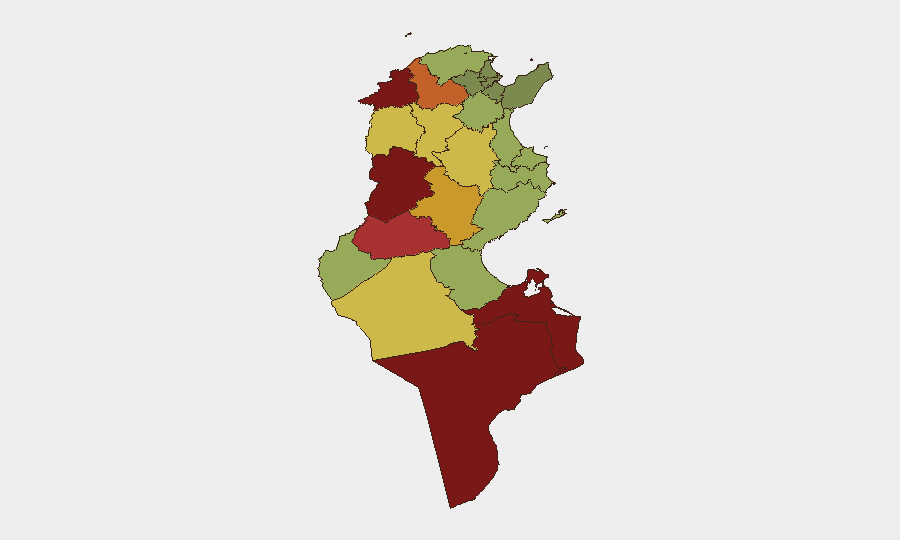
Kasserine, Jendouba, and Tataouine governorates consistently rank as Tunisia's highest-risk regions (scores 92, 88, and 85 respectively), driven by socioeconomic marginalization, limited service provision, and historical grievance. However, near-term operational risk is concentrated in central Tunis, where political mobilization and protest infrastructure are most active, and in coastal and interior governorates (Mahdia, Sfax, Ben Arous) where service disruptions and labor actions pose immediate logistics and mobility challenges. The top-ranked southern and western regions remain structurally fragile but are currently experiencing fewer acute triggering events than the capital.
How GeoBit Would Assist
Organizations operating in Tunisia should employ AOI Monitoring & Early Warning on central Tunis (Place du Passage, Avenue Habib Bourguiba) and key infrastructure zones (Radès, Skhira) for real-time alerting of protests, blockages, or disruptions. Routing & Network Analysis can provide alternative mobility plans around recurring protest corridors and fuel-distribution pinch points. Intelligence & OSINT (including social-media and civic-group sentiment analysis) enables tracking of planned mobilizations and labor actions before they occur.
7-Day Outlook
Protests and demonstrations are likely to continue or intensify over the coming week, particularly around political demands and service shortages. Central Tunis and coastal water-stressed regions should be assumed to carry sustained risk of spontaneous or organized gatherings, traffic restrictions, and short-notice labor actions affecting fuel and transport. Monitoring for escalation signals (large-scale arrests, clashes, or coordinated national strikes) remains essential for duty-of-care planning.
Highest-Risk Areas — Ranked
| # | State / Region | Risk |
|---|---|---|
| 1 | Kasserine | 92 |
| 2 | Jendouba | 88 |
| 3 | Tataouine | 85 |
| 4 | Médenine | 83 |
| 5 | Gafsa | 78 |
| 6 | Béja | 75 |
| 7 | Sidi Bouzid | 72 |
| 8 | Al Kaf | 70 |
| 9 | Kébili | 68 |
| 10 | Kairouan | 65 |
| 11 | Siliana | 62 |
| 12 | Tozeur | 58 |
Sources
Previous Daily Briefs
A new Tunisia brief is written every day — each with its own risk map and downloadable CSV. Here's the last week; use the calendar to go further back.
- August 19, 2026
- August 17, 2026
- August 15, 2026
- August 13, 2026
- August 11, 2026
- August 9, 2026
- August 7, 2026
📅 Browse every day by calendar →
Highlighted days have a brief. Tap a day for that day's map & analysis, or “csv” for that day's dataset ($5).
Atlas — our AI intelligence desk — emails them this snapshot personally. Nothing else, no list.