Situation Summary
Estonia remains at low overall threat level (rank #115 globally) with no confirmed large-scale incidents or civil unrest in the last 24–48 hours. However, official rhetoric from Estonian leadership has intensified warnings about Russian hybrid threats—including cyber operations, sabotage, and airspace violations—reflecting a sustained vigilance posture in response to regional destabilization. The country faces a combination of persistent cross-border pressure and localized infrastructure/safety incidents, but no acute systemic crisis.
Key Developments
- Tallinn, 27 Aug 2026: Foreign Minister Margus Tsahkna reiterated that Estonia's military threat assessment from Russia remains unchanged, but publicly urged NATO allies to take seriously the risk of Russian provocations, citing concern over hybrid attacks in the Baltic region and recent CIA–Moscow diplomatic contact.
- Baltic region (Estonia included), 27 Aug 2026: Regional security officials warned of a "deteriorating security environment" linked to increased Russian airspace violations and drone incursions, characterized as part of broader hybrid pressure against Baltic NATO members; no specific new incursion confirmed in Estonia territory in the immediate window.
- Tallinn / national defense sector, 27 Aug 2026: Estonian authorities reiterated accusations that Russia is conducting coordinated cyberattacks, sabotage attempts, and influence operations; recent arson at Milrem Robotics (a defense contractor) was cited as evidence of this broader pattern.
- Haljala vald, Lääne-Viru County (Vizu settlement), 26–27 Aug 2026: Emergency services responded to a residential fire late on 26 Aug; rescuers discovered a deceased male on the morning of 27 Aug. Currently treated as a local safety incident with no indication of malicious cause.
- Tartu, 26 Aug 2026: Part of Miina Härma Gymnasium's building collapsed; reported as a structural/infrastructure failure rather than a deliberate attack, affecting local school operations and safety.
- Tallinn, 26 Aug 2026 (decision reported 27 Aug): Harju County Court denied early release for Denis Metsavas, a former Defence Forces major convicted of state treason and cooperation with Russian military intelligence; politically sensitive but no associated unrest reported.
- National, 27 Aug 2026: Ministry of Justice and Digital Affairs released first-half 2026 crime statistics showing 14,601 offences—a 6% year-on-year increase, driven primarily by property crimes.
Highest-Risk Areas
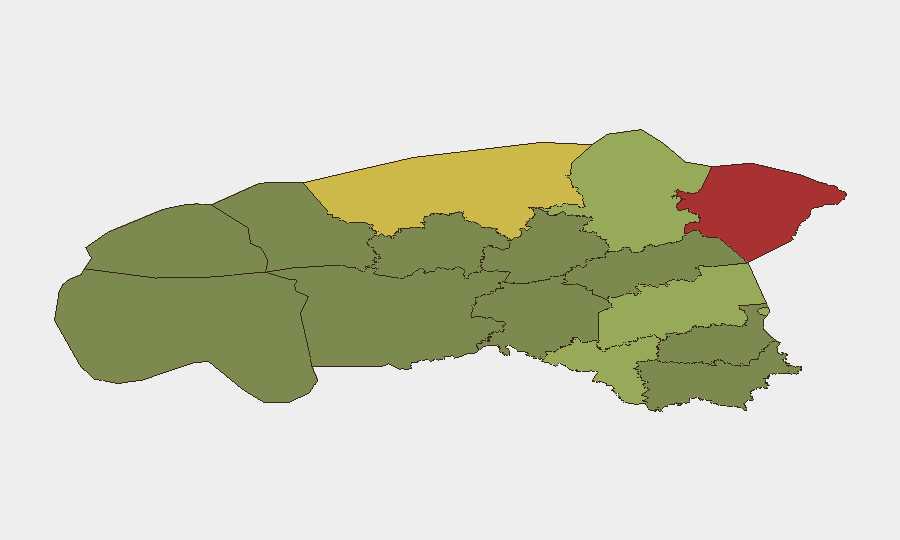
Ida-Viru County (risk 78) and Harju County (risk 68) drive the nation's sub-national threat profile, reflecting their proximity to the Russian border and greater exposure to cross-border hybrid threats, respectively. Tartu County (risk 58) and Valga County (risk 55) also carry elevated scores, likely linked to regional defense infrastructure, cyber-critical assets, and border vulnerability. Southern and western counties (Võru, Viljandi, Põlva) register significantly lower risk, indicating that hybrid and cross-border threat concentration is geographically polarized toward the northeast and capital region.
How GeoBit Would Assist
Security teams monitoring Estonia would employ Intel Sweep and multi-language OSINT feeds to track Russian hybrid rhetoric and military posturing in real time, AOI Monitoring to maintain persistent watch on Ida-Viru and Harju County critical infrastructure and airspace, and Network & Actor Analysis to identify coordination patterns in cyber and sabotage operations targeting defense contractors and state systems. Sentiment & temporal analysis of official and Russian state communications would provide early warning of escalation in hybrid pressure, while satellite imagery and GIS analysis would support assessment of cross-border activity and infrastructure vulnerability.
7-Day Outlook
Estonia is expected to maintain a heightened vigilance posture without acute escalation. Official warnings about Russian provocation will likely persist, and airspace monitoring will remain elevated. Localized incidents (fire, infrastructure failure) may continue at baseline frequency, but no systemic breakdown or major attack is anticipated in the near term unless regional tensions sharpen substantially.
Highest-Risk Areas — Ranked
| # | State / Region | Risk |
|---|---|---|
| 1 | Ida-Viru County | 78 |
| 2 | Harju County | 68 |
| 3 | Tartu County | 58 |
| 4 | Valga County | 55 |
| 5 | Lääne-Viru County | 52 |
| 6 | Pärnu County | 35 |
| 7 | Rapla County | 32 |
| 8 | Jõgeva County | 30 |
| 9 | Järva County | 28 |
| 10 | Viljandi County | 25 |
| 11 | Põlva County | 22 |
| 12 | Võru County | 18 |
Sources
Previous Daily Briefs
A new Estonia brief is written every day — each with its own risk map and downloadable CSV. Here's the last week; use the calendar to go further back.
- August 25, 2026
- August 23, 2026
- August 21, 2026
- August 19, 2026
- August 17, 2026
- August 15, 2026
- August 13, 2026
📅 Browse every day by calendar →
Highlighted days have a brief. Tap a day for that day's map & analysis, or “csv” for that day's dataset ($5).
Atlas — our AI intelligence desk — emails them this snapshot personally. Nothing else, no list.