Situation Summary
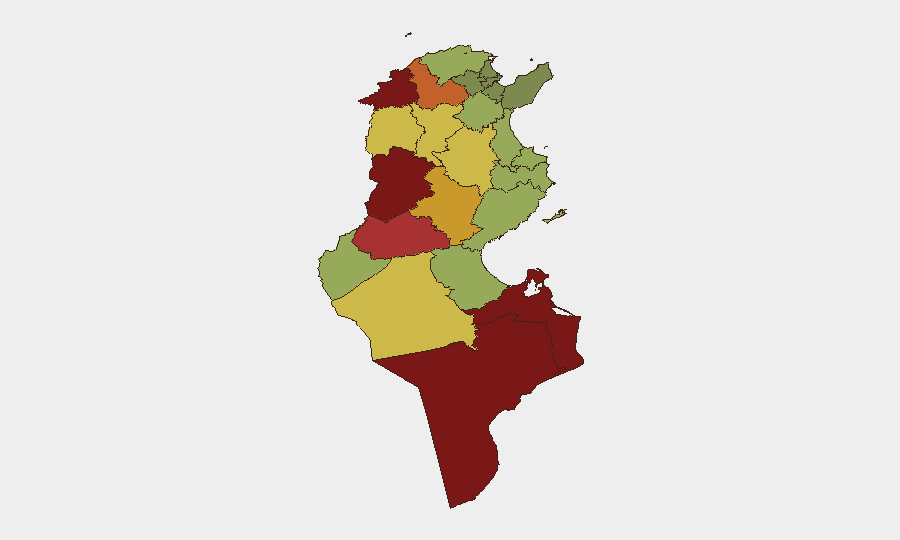
Tunisia remains at composite global threat rank #73 with civil unrest as the primary driver. The country is experiencing a concurrent surge in anti-government protests (21–22 August) over political repression and service failures, and a spike in maritime migrant incidents along the southeastern coast (22 August). While the national threat score remains moderate (24), sub-national disparities are acute, with five governorates in the south and west scoring above 75, reflecting underlying fragmentation and institutional stress.
Key Developments
- Tunis (capital) – 21 August evening – Hundreds of protesters gathered in downtown Tunis demanding President Kais Saied step down and denouncing "one-man rule"; demonstrations organized by the Nafas movement focused on water shortages, electricity cuts, and detention of opposition activists.
- Multiple regions – 20–21 August – Coordinated wave of anti-government protests across Tunis explicitly rejecting "one-man rule" and demanding restoration of democratic institutions; concurrent labor action (fuel truck drivers' strike blocking Radès petroleum distribution on 20 August) and localized service-access protests (Mahdia water rights demonstration).
- Zarzis offshore (Médenine governorate) – 22 August – Migrant vessel sank approximately 14 nautical miles off coast; Tunisian Coast Guard rescued two survivors (one critical condition) and reported approximately 13 missing; ongoing search-and-rescue operations.
- Ben Guerdane / Zarzis maritime sector (Médenine) – night of 22 August – Second migrant shipwreck with vessel carrying 15+ persons; at least 4 bodies recovered, 10+ missing; maritime security units conducting continuing search operations.
- Jerjis coastline (south Tunisia) – 22 August – Security forces rescued one survivor from irregular migration boat sinking approximately 14 nautical miles offshore; vessel reportedly carried ~15 people; investigation opened; additional missing persons.
- Countrywide – recent weeks through 21–22 August – Tunisian Forum for Social and Economic Rights (FTDES) documented hundreds of dispersed protests over drinking water scarcity and electricity outages amid extreme heat; pattern reflects systemic infrastructure and service-delivery crisis.
Highest-Risk Areas
Kasserine (risk 92), Jendouba (88), and Tataouine (85) lead sub-national rankings, with Médenine (83) and Gafsa (78) following. Southwestern and western governorates concentrate risk due to economic marginalization, limited service provision, and proximity to Libyan border instability. The southern coastal belt—Médenine, Tataouine, Kébili—combines acute maritime migration pressure with socioeconomic grievances; recent shipwrecks and ongoing search operations underscore operational strain on coastal security infrastructure. These zones are decoupling from central authority capacity and are vulnerable to further fragmentation if service delivery and political channels do not stabilize.
How GeoBit Would Assist
Security teams with personnel or assets in Tunisia should deploy AOI Monitoring & Early Warning on Kasserine, Jendouba, and Médenine to track protest mobilization, labor actions, and migration-related incidents in real time. Intel Sweep, OSINT fusion, and Telegram/X intelligence enable continuous tracking of opposition rhetoric, strike organization, and coastal smuggling-network activity. Routing & Network Analysis supports rapid contingency planning for supply-chain and personnel movement, particularly for fuel and water-dependent operations in high-risk governorates.
7-Day Outlook
Anti-government protest activity is likely to persist through late August, with secondary risk of labor actions disrupting fuel and water distribution in urban centers. Maritime migrant incidents will continue as seasonal migration pressure remains high and Tunisian Coast Guard capacity is stretched. Escalation risk is moderate if security forces move to disperse major protests; de-escalation depends on partial concessions on service delivery or political dialogue.
Highest-Risk Areas — Ranked
| # | State / Region | Risk |
|---|---|---|
| 1 | Kasserine | 92 |
| 2 | Jendouba | 88 |
| 3 | Tataouine | 85 |
| 4 | Médenine | 83 |
| 5 | Gafsa | 78 |
| 6 | Béja | 75 |
| 7 | Sidi Bouzid | 72 |
| 8 | Al Kaf | 70 |
| 9 | Kébili | 68 |
| 10 | Kairouan | 65 |
| 11 | Siliana | 62 |
| 12 | Tozeur | 58 |
Sources
Previous Daily Briefs
A new Tunisia brief is written every day — each with its own risk map and downloadable CSV. Here's the last week; use the calendar to go further back.
- August 21, 2026
- August 19, 2026
- August 17, 2026
- August 15, 2026
- August 13, 2026
- August 11, 2026
- August 9, 2026
📅 Browse every day by calendar →
Highlighted days have a brief. Tap a day for that day's map & analysis, or “csv” for that day's dataset ($5).
Atlas — our AI intelligence desk — emails them this snapshot personally. Nothing else, no list.