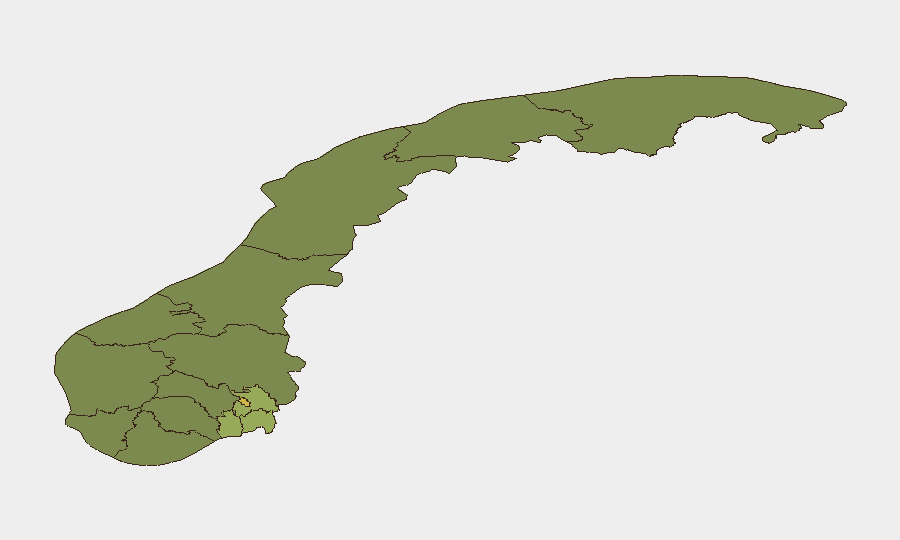
Situation Summary
Norway remains a stable, low-threat jurisdiction (global rank #54, composite score 35), with no discrete security events recorded in GeoBit's formal tracking window. However, the past week has surfaced elevated risks tied to geopolitical spillover from the Ukraine–Russia conflict, including drone activity near Norwegian airspace, cyberattacks on public-sector infrastructure, and Russian military posturing along the Finnmark border. Oslo dominates sub-national risk (score 68), driven by diplomatic exposure and urban crime; localized street violence and robbery incidents add minor but measurable personal-safety concerns in secondary urban centers.
Key Developments
- Oslo / Moldova–Norway air corridor, 2026-09-09: Ukrainian President Zelenskyy's aircraft en route to King Harald V's funeral in Oslo was nearly struck by a Russian drone departing Moldova, prompting immediate diplomatic and security concern over the vulnerability of high-profile travel to Norway during the current geopolitical environment. Moldovan authorities confirmed Russian drone activity near the Starokozache border checkpoint delayed departure.
- Svalbard Arctic waters, disclosed 2026-09-10 (activity earlier in spring): NATO partners (Britain, Norway, US) tracked and confronted Russian submarines conducting training operations aimed at sabotaging subsea communication cables near Svalbard. No cables were damaged, but the incident underscores Russian strategic interest in Norwegian critical undersea infrastructure.
- Norway national (public-sector IT), reported 2026-09-10: Norwegian Digitalisation Agency, universities, and colleges experienced denial-of-service cyberattacks disrupting public IT services. Attacks coincided with major state events and may reflect broader state-sponsored or activist targeting of Norwegian institutions.
- Finnmark (Russian border), 2026-09-07–10: Russian officials publicly condemned Norway's deployment of US intermediate-range missile launch systems and formation of a new artillery division in the Finnmark brigade (equipped with K9 self-propelled guns), characterizing the moves as destabilizing. Information operations amplifying these complaints continue through the week.
- Tønsberg city centre (Vestfold), 2026-09-09: A woman in her 60s was violently robbed of her purse; force was used and the victim injured. The incident reflects elevated street crime risk in secondary urban centers outside Oslo.
- Shopping mall, Norway, 2026-09-08: A violence incident at an unspecified shopping mall prompted police response, indicating isolated public-order concerns in commercial spaces.
- Agder court ruling, 2026-09-09: Agder Court of Appeal acquitted an 18-year-old of complicity in an aggravated knife robbery at Å school, finding him a passive bystander. While the underlying robbery predates this week, the ruling reinforces perceptions of youth violence and judicial outcomes in the region.
- Wolf poaching sentences, 2026-09-12: Ten Norwegians received long prison sentences for illegal wolf hunting, underscoring enforcement tensions in rural areas and broader state–community regulation friction.
Highest-Risk Areas
Oslo dominates risk (68) due to diplomatic exposure, state infrastructure concentration, and urban crime prevalence. Surrounding Akershus (52) and Østfold (48) counties experience secondary urban and commuter-belt crime, robbery, and theft. Vestfold and Rogaland (42 and 38) register moderate risk driven by street violence and property crime. The Finnmark border region, while not in the top rankings, presents acute geopolitical and critical-infrastructure risk given Russian military posturing and subsea-cable vulnerability. Northern regions remain low-risk but warrant monitoring for Arctic strategic competition spillover.
How GeoBit Would Assist
Security teams protecting personnel and assets in Norway should deploy AOI Monitoring & Early Warning on Oslo diplomatic zones, Finnmark border areas, and critical undersea-cable landing sites; Intel Sweep and Telegram/X OSINT to track Russian military signaling and information operations; and Network & Actor Analysis to map threat groups targeting public-sector IT infrastructure. Maritime & Aviation tracking provides real-time monitoring of high-risk transit corridors, particularly those used by state visitors.
7-Day Outlook
Elevated geopolitical tension and Russian military/information operations will likely persist, particularly around Finnmark and state events. Cyberattacks on public-sector targets may recur. Street crime in Oslo and secondary urban areas will remain a routine duty-of-care concern; no major escalation is anticipated absent new Ukraine–Russia developments.
Highest-Risk Areas — Ranked
| # | State / Region | Risk |
|---|---|---|
| 1 | Oslo | 68 |
| 2 | Akershus | 52 |
| 3 | Østfold | 48 |
| 4 | Vestfold | 42 |
| 5 | Rogaland | 38 |
| 6 | Buskerud | 35 |
| 7 | Trøndelag | 32 |
| 8 | Telemark | 28 |
| 9 | Vestland | 27 |
| 10 | Agder | 26 |
| 11 | Møre og Romsdal | 22 |
| 12 | Innlandet | 20 |
Sources
Previous Weekly Briefs
A new Norway brief is written every Monday, covering the week — each with its own risk map and downloadable CSV. Use the calendar to go further back.
- September 7, 2026
- September 2, 2026
- September 1, 2026
- August 31, 2026
- August 30, 2026
- August 29, 2026
- August 28, 2026
📅 Browse past briefs by calendar →
Highlighted days have a brief. Tap a day for that day's map & analysis, or “csv” for that day's dataset ($5).
Atlas — our AI intelligence desk — emails them this snapshot personally. Nothing else, no list.