Situation Summary
Tunisia remains at composite threat level #73 globally, with civil unrest as the primary driver. The past 48 hours have seen acute localized unrest in the southeast (Médenine Governorate) triggered by the sinking of a migrant vessel off Zarzis on 20 August, with violent street clashes in Ben Guerdane on 23–24 August. Concurrently, opposition protests in the capital over governance and basic service delivery persist, maintaining elevated baseline risk in urban centers.
Key Developments
- Ben Guerdane (Médenine) – Night of 23–24 August, continuing into 24–25 August: Young residents staged violent protests after learning of a migrant boat sinking with ~15 local passengers; demonstrators blocked roads, burned tires, and threw stones and fireworks at security forces, which responded with tear gas. Security forces re-established control of main roads and commercial areas by morning on 24 August, though heavy presence and community tensions remained.
- Off Zarzis coast – Search and recovery operations (22–25 August): Tunisian National Guard and coast guard units, supported by volunteer fishers, continued recovery operations for the migrant vessel that sank ~14 nautical miles offshore on 20 August. By 24–25 August, at least 11–12 bodies had been recovered, with 2 still missing; the slow recovery pace and potential imminent end to search operations have fueled local anger and suspicion of authorities.
- Ben Guerdane and coastal communities (24–25 August): Civil society groups and migrant-rights organizations publicly criticized state migration policies and economic conditions driving irregular sea crossings, citing lack of jobs, services, and safe migration channels. These statements, circulated regionally and internationally, underscore persistent grievances and carry risk of renewed localized unrest, though no large-scale protests beyond Ben Guerdane have been documented in the past 24 hours.
- Tunis and major urban centers (prior days, continuing risk): Opposition groups remain mobilized over power cuts, water shortages, and President Kais Saïed's rule. Hundreds protested on 20–21 August demanding his resignation and release of political detainees; no de-escalation reported through 24–25 August, implying elevated baseline risk of further demonstrations and security-force presence in capital and other cities.
Highest-Risk Areas
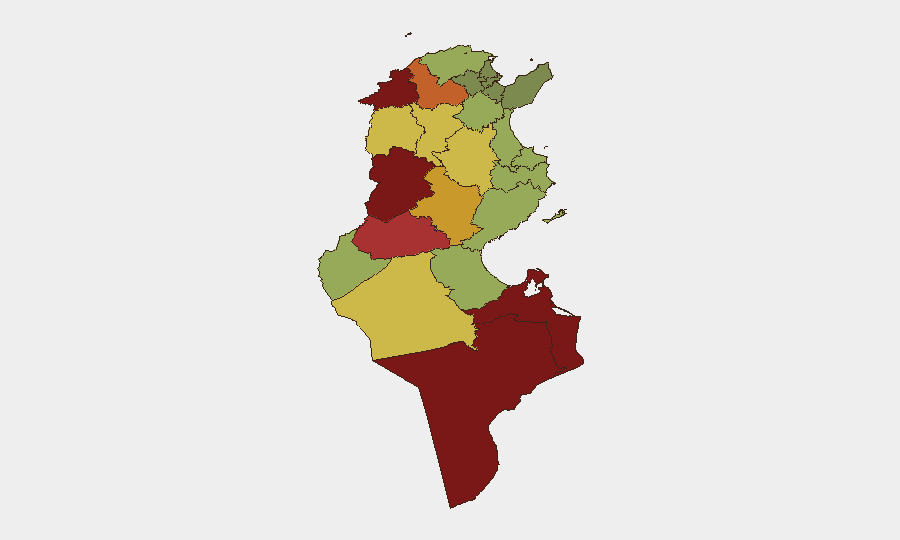
Kasserine (92), Jendouba (88), and Tataouine (85) hold the highest sub-national scores; however, Médenine (83) and the coastal southeast are the immediate focus, driven by the migrant-boat disaster, violent street unrest in Ben Guerdane, and ongoing family grief and anger over recovery operations. Western and southwestern borderland governorates—Kasserine, Gafsa, Sidi Bouzid, and Béja—remain chronically elevated due to historical economic hardship, irregular migration activity, and security-force operations. The capital-region concentration of governance-related protests adds persistent medium-level risk to central urban corridors.
How GeoBit Would Assist
Security teams should deploy AOI Monitoring & Early Warning with persistent alerts on Ben Guerdane and coastal Médenine to detect renewed protests or roadblocks in real time. Intel Sweep and multi-language OSINT (X/Twitter, Telegram, local Arabic media) will track opposition messaging in Tunis and civil-society statements on migration policy, enabling early detection of coordinated demonstrations. Routing & Network Analysis will identify alternative transport and personnel routes around high-risk zones and temporary access restrictions tied to security operations.
7-Day Outlook
Immediate risk (next 48–72 hours) remains elevated in Ben Guerdane and surrounding areas as search operations conclude and families process losses; secondary protests or roadblocks are possible. Tunis-based opposition activity will likely persist at baseline levels, with ad hoc gatherings and increased security presence. By end of week, attention may shift from the maritime disaster to broader economic and political grievances, though no major escalation is currently forecast absent a triggering event.
Highest-Risk Areas — Ranked
| # | State / Region | Risk |
|---|---|---|
| 1 | Kasserine | 92 |
| 2 | Jendouba | 88 |
| 3 | Tataouine | 85 |
| 4 | Médenine | 83 |
| 5 | Gafsa | 78 |
| 6 | Béja | 75 |
| 7 | Sidi Bouzid | 72 |
| 8 | Al Kaf | 70 |
| 9 | Kébili | 68 |
| 10 | Kairouan | 65 |
| 11 | Siliana | 62 |
| 12 | Tozeur | 58 |
Sources
Previous Daily Briefs
A new Tunisia brief is written every day — each with its own risk map and downloadable CSV. Here's the last week; use the calendar to go further back.
- August 23, 2026
- August 21, 2026
- August 19, 2026
- August 17, 2026
- August 15, 2026
- August 13, 2026
- August 11, 2026
📅 Browse every day by calendar →
Highlighted days have a brief. Tap a day for that day's map & analysis, or “csv” for that day's dataset ($5).
Atlas — our AI intelligence desk — emails them this snapshot personally. Nothing else, no list.