Situation Summary
Estonia remains a low-threat operating environment (global rank #129, composite score 13) with no tracked security events in the current assessment window. However, the past week has revealed persistent localized violent crime, active labor unrest tied to public-sector wage demands, and heightened national-security vigilance regarding Russian border contingencies and drone incursions. The threat landscape is regionally concentrated in the northeast and capital region, with no systemic instability but elevated operational friction in specific localities.
Key Developments
- Kohtla‑Järve, Ida‑Viru County – 15 Sep 2026: A planned confrontation between rival groups on Endla Street resulted in a fatal stabbing of a 21‑year‑old; police detained multiple participants and launched a manhunt for three identified suspects, underscoring organized group-violence risk in the county.
- Tallinn – 15 Sep 2026: Teachers and rescue workers staged a protest outside the Riigikogu demanding significant public-sector wage increases; organizers announced a nationwide one‑hour warning strike scheduled for 22 September (preschools 08:00–09:00, schools 09:00–10:00).
- Tartu – 10 Sep incident, reported 18 Sep 2026: Police detained a 21‑year‑old and 15‑year‑old on suspicion of assault and unlawful abduction of a 63‑year‑old man in the city center; both suspects were taken into custody.
- Tallinn – 16–17 Sep 2026: Authorities revoked the residence permit and deported a Russian national with a ten‑year entry ban following over 250 recorded incidents involving violence, property crime, and threats against Ukrainians; framed as a national-security measure.
- Tallinn – 16 Sep 2026: Harju County Court began proceedings in the criminal case of Oleg Bessedin, accused of crimes against the Estonian state and sanctions violations; Bessedin agreed to a plea bargain potentially resulting in a seven‑year sentence.
- Estonia (national level) – 18 Sep 2026: Economy and Infrastructure Minister Kristen Michal stated that Estonia is prepared to rapidly tighten or close its border with Russia in response to a potential Russian general mobilization announcement following State Duma elections.
- Baltic airspace – 15 Sep reporting: Ongoing drone incursions and tracking continue along NATO's Baltic and Finnish borders; no new shoot‑downs were reported in Estonia this week, but regional concern over spillover from the Ukraine conflict remains elevated.
Highest-Risk Areas
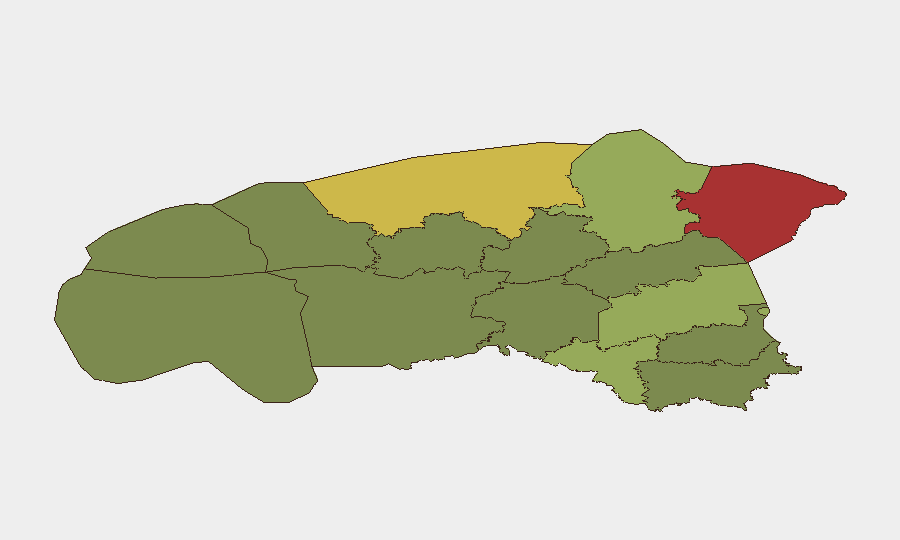
Ida‑Viru County (risk 78) and Harju County (risk 68) dominate the sub-national ranking, reflecting concentrated violent crime, organized group confrontations, and cross-border security sensitivities in the northeast and capital region. Tartu County (risk 58) rounds out the top tier, driven by reported violent assault and abduction incidents. The clustering of risk in these three counties—industrial northeast, capital metro, and university city—suggests that localized organized violence, criminal networks, and border-adjacent vulnerabilities are the primary drivers rather than systemic state-level instability.
How GeoBit Would Assist
Teams with operations in Estonia should deploy AOI Monitoring & Early Warning on Ida‑Viru and Harju counties to track emerging group-violence signals and labor action escalation in real time. Network & Actor Analysis applied to criminal and protest-organization data would enable identification of key players and predictive routing to avoid high-risk encounters. Multi-language OSINT fusion across Estonian and Russian-language social media and Telegram channels would provide early signals of border-policy shifts or cross-border spillover threats.
7-Day Outlook
The scheduled 22 September teachers' strike and ongoing wage-demand momentum suggest sustained labor friction through September; operational disruptions to schools and public services are likely contained but should be anticipated for contingency planning. Border-tightening rhetoric remains speculative pending Russian political developments, but heightened vigilance at the Russia boundary should be assumed. Violent-crime incidents are episodic rather than systemic; localized risk in the northeast and Tartu will persist at current levels absent major triggering events.
Highest-Risk Areas — Ranked
| # | State / Region | Risk |
|---|---|---|
| 1 | Ida-Viru County | 78 |
| 2 | Harju County | 68 |
| 3 | Tartu County | 58 |
| 4 | Valga County | 55 |
| 5 | Lääne-Viru County | 52 |
| 6 | Pärnu County | 35 |
| 7 | Rapla County | 32 |
| 8 | Jõgeva County | 30 |
| 9 | Järva County | 28 |
| 10 | Viljandi County | 25 |
| 11 | Põlva County | 22 |
| 12 | Võru County | 18 |
Sources
Previous Weekly Briefs
A new Estonia brief is written every Monday, covering the week — each with its own risk map and downloadable CSV. Use the calendar to go further back.
- September 14, 2026
- September 7, 2026
- September 1, 2026
- August 30, 2026
- August 27, 2026
- August 25, 2026
- August 23, 2026
📅 Browse past briefs by calendar →
Highlighted days have a brief. Tap a day for that day's map & analysis, or “csv” for that day's dataset ($5).
Atlas — our AI intelligence desk — emails them this snapshot personally. Nothing else, no list.