Situation Summary
Estonia remains a low-threat environment globally (rank #130, composite score 13) with no tracked security events in the current reporting week. However, official attribution of a major sabotage attack against a defence-technology company to Russian state actors, coupled with elevated risk in border and northeastern regions, reflects persistent state-level hostility and asymmetric threat activity. The security posture remains stable but contingent on sustained vigilance in critical infrastructure and sensitive sectors.
Key Developments
- Tallinn, Lasnamäe — 29 September 2026: Estonia's Internal Security Service publicly attributed the 15 August arson at Milrem Robotics (defence-technology company, Betooni Street) to deliberate, pre-planned sabotage commissioned by Russian security services. Three suspects were detained and transferred to Estonia prior to the public announcement; criminal proceedings remain ongoing.[1][3][7][9]
- Tallinn — 29 September 2026: Estonia's Foreign Ministry summoned Russia's chargé d'affaires to formally protest the alleged sabotage operation and announced measures to strengthen preparedness against hostile state activity.[4]
- Russia — 29 September 2026: Russia denied responsibility for the Milrem attack; Estonian authorities countered that the operational modus operandi aligns with other documented Russian-linked sabotage incidents across Europe.[1][5][9]
- General: Two separate incidents involving police use of force were recorded in the past week (a police officer assault on 25 September and a fatal officer-involved shooting on 24 September), though neither has been substantively linked to broader security threats or foreign actors.
Highest-Risk Areas
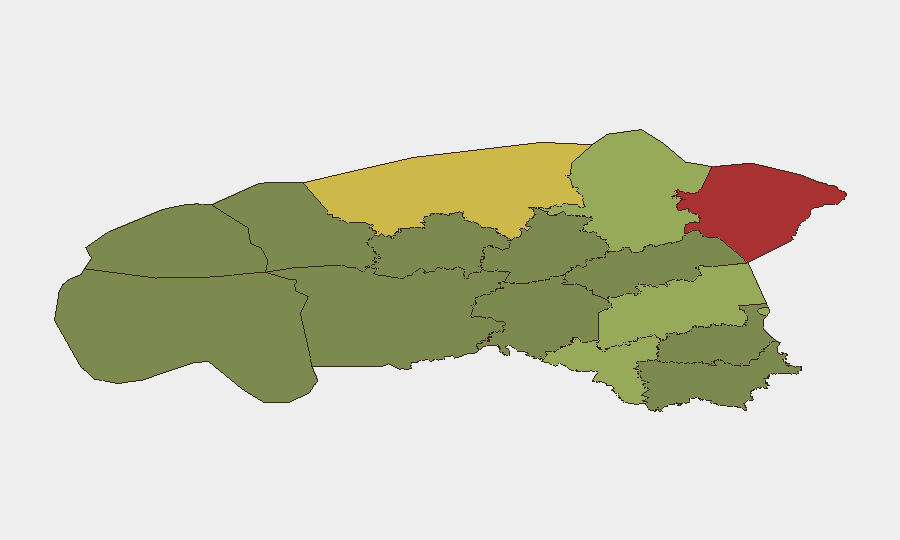
Ida-Viru County (risk score 78) and Harju County (68) dominate the sub-national risk profile and warrant prioritized attention. Ida-Viru's elevated score reflects its proximity to the Russian border and historical significance as a transit and industrial zone; Harju County, containing Tallinn, combines critical infrastructure concentration, state-actor targeting (as exemplified by the Milrem incident), and dense population. Tartu County (58) and Valga County (55) follow as secondary concern areas. The disparity between northern/northeastern counties and southern regions underscores the geographic specificity of state-directed and transnational threats; southern and central counties register substantially lower composite scores.
How GeoBit Would Assist
Intel Sweep and OSINT Fusion capabilities enable continuous monitoring of foreign-actor targeting patterns, media reporting, and diplomatic signaling to identify planned or emerging sabotage operations against Estonian critical infrastructure and defence sectors. AOI Monitoring & Early Warning with persistent geographic focus on Ida-Viru and Harju counties—particularly defence, energy, and telecommunications assets—provides alerting when indicators of reconnaissance, suspicious personnel activity, or operational staging emerge. Network & Actor Analysis tracking Russian state-security service cells, procurement networks, and logistical pathways offers predictive insight into the timing and target-set of future attacks, enabling asset hardening and protective measures before incidents occur.
7-Day Outlook
No imminent escalation is indicated; however, the public attribution and diplomatic protest are likely to trigger a period of heightened Russian counter-messaging and, potentially, secondary targeting of Estonian government or private-sector entities perceived as responsible for the disclosure. Corporate and government security teams in Tallinn, Lasnamäe, and other Harju locations should maintain elevated vigilance on facility access, personnel vetting, and cyber-perimeter defences over the next 10–14 days.
Highest-Risk Areas — Ranked
| # | State / Region | Risk |
|---|---|---|
| 1 | Ida-Viru County | 78 |
| 2 | Harju County | 68 |
| 3 | Tartu County | 58 |
| 4 | Valga County | 55 |
| 5 | Lääne-Viru County | 52 |
| 6 | Pärnu County | 35 |
| 7 | Rapla County | 32 |
| 8 | Jõgeva County | 30 |
| 9 | Järva County | 28 |
| 10 | Viljandi County | 25 |
| 11 | Põlva County | 22 |
| 12 | Võru County | 18 |
Sources
Previous Weekly Briefs
A new Estonia brief is written every Monday, covering the week — each with its own risk map and downloadable CSV. Use the calendar to go further back.
- September 28, 2026
- September 21, 2026
- September 14, 2026
- September 7, 2026
- September 1, 2026
- August 30, 2026
- August 27, 2026
📅 Browse past briefs by calendar →
Highlighted days have a brief. Tap a day for that day's map & analysis, or “csv” for that day's dataset ($5).
Atlas — our AI intelligence desk — emails them this snapshot personally. Nothing else, no list.