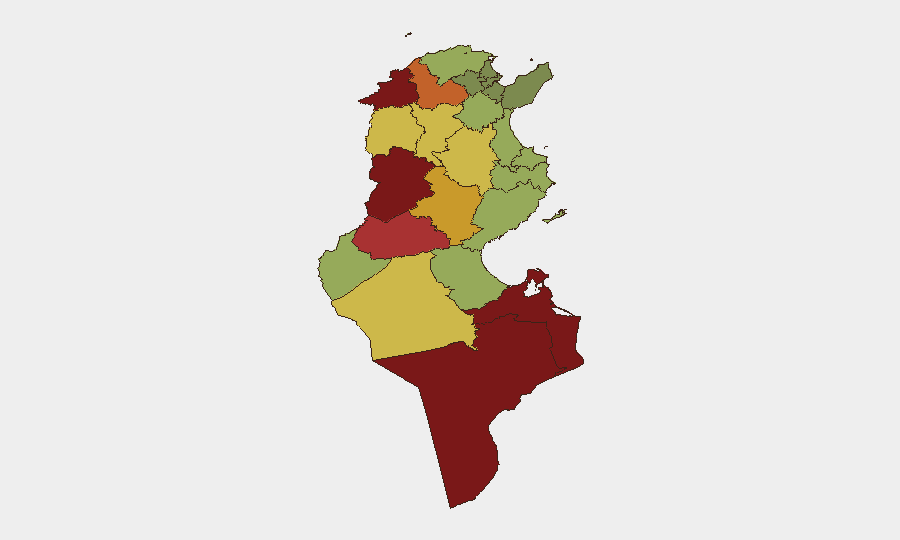
Situation Summary
Tunisia entered the week of 8–15 September 2026 amid a convergence of civil-society pressure, organized-crime enforcement, and labor-union mobilization. A high-profile journalist arrest and detention on financial charges triggered press-freedom protests and a planned national march by the Tunisian General Labor Union (UGTT), while simultaneous anti-narcotics raids dismantled a cocaine trafficking network in Greater Tunis and unemployed graduates staged coordinated road blockades across interior regions. The national threat ranking remains moderate (composite score 26, #77 globally), but sub-national volatility—particularly in Kasserine, Jendouba, and Tataouine—reflects entrenched regional marginalization, organized crime, and state pressure on civic space.
Key Developments
- Tunis (Greater Tunis: Lac, La Marsa, Gammarth, La Manouba) – 14 September 2026
National Guard raids dismantled a cocaine trafficking network, arrested 13 suspects including a well-known rapper, and seized significant quantities of cocaine, cash, a drone, and high-end vehicles.
- Sidi Bouzid, Kebili, Gafsa – 14 September 2026
University graduates demanding employment staged coordinated protests involving tire-burning and road blockades; clashes with law enforcement were reported across all three interior governorates.
- Tunis (Economic & Financial Judicial Pole, central Tunis) – 8 September 2026
Journalists and civil-society representatives held press-freedom protests demanding the release of journalist Mohamed Yousfi, arrested on 4 September near Express FM and placed in pre-trial detention on charges related to financial crime.
- Tunis (central) – 8 September 2026
The national journalists' union held a separate rally to protest alleged media crackdowns and call for Yousfi's release, elevating the case as a broader freedom-of-expression flashpoint.
- Nationwide (UGTT) – 9 September 2026
The UGTT announced preparation of a national march coordinated with civil society in response to Yousfi's arrest and broader crackdowns on independent voices, signaling potential escalation toward large-scale social mobilization.
- Meknassi (Sidi Bouzid) & Habib Bourguiba Avenue, central Tunis – around 9 September 2026
Unemployed youth stormed the Meknassi local delegation; subsequent marches to central Tunis resulted in clashes with security forces and at least three arrests.
- Tunis (pre-trial detention) – 10–11 September 2026
Four activists detained for organizing a pro-Palestinian flotilla remained in custody; one detainee in their fourth week of hunger strike faces a court appearance scheduled for 16 September.
- Nationwide – 9 September 2026
A report to the UN Human Rights Council documented systematic crackdowns on human-rights defenders and civil-society associations, citing arbitrary detention and legal pressure.
- Nationwide (drug-policy) – 14 September 2026
Authorities signaled plans to revise Tunisia's 1992 narcotics law to strengthen enforcement against organized drug-trafficking networks.
Highest-Risk Areas
Kasserine, Jendouba, and Tataouine dominate the sub-national risk landscape (scores 92, 88, and 85 respectively), driven by entrenched unemployment, regional economic marginalization, and organized-crime presence. This week's coordinated graduate protests in Sidi Bouzid, Kebili, and Gafsa (scores 72, 68, and 78) underscore how interior governorates remain flashpoints for socio-economic grievance and protest activity. These regions, combined with persistent security pressures on civil society nationwide, present elevated risk for road disruptions, sporadic clashes with security forces, and potential criminal activity.
How GeoBit Would Assist
Security teams should deploy AOI Monitoring & Early Warning to track Kasserine, Jendouba, and Sidi Bouzid for protest activity and roadblocks; use OSINT fusion (X, Telegram, local news feeds) to monitor UGTT announcements and activist coordination; and employ Network & Actor Analysis to map labor-union and civil-society leadership around the planned national march and Yousfi case developments.
7-Day Outlook
The scheduled 16 September court appearance for detained flotilla activists and the UGTT's planned national march are immediate flashpoints. Expect continued labor-union and civil-society mobilization around press freedom and unemployment through mid-to-late September, with sustained risk of road blockades, clashes, and disruptions in interior regions and central Tunis.
Highest-Risk Areas — Ranked
| # | State / Region | Risk |
|---|---|---|
| 1 | Kasserine | 92 |
| 2 | Jendouba | 88 |
| 3 | Tataouine | 85 |
| 4 | Médenine | 83 |
| 5 | Gafsa | 78 |
| 6 | Béja | 75 |
| 7 | Sidi Bouzid | 72 |
| 8 | Al Kaf | 70 |
| 9 | Kébili | 68 |
| 10 | Kairouan | 65 |
| 11 | Siliana | 62 |
| 12 | Tozeur | 58 |
Sources
Previous Weekly Briefs
A new Tunisia brief is written every Monday, covering the week — each with its own risk map and downloadable CSV. Use the calendar to go further back.
- September 8, 2026
- September 2, 2026
- August 31, 2026
- August 29, 2026
- August 27, 2026
- August 25, 2026
- August 23, 2026
📅 Browse past briefs by calendar →
Highlighted days have a brief. Tap a day for that day's map & analysis, or “csv” for that day's dataset ($5).
Atlas — our AI intelligence desk — emails them this snapshot personally. Nothing else, no list.