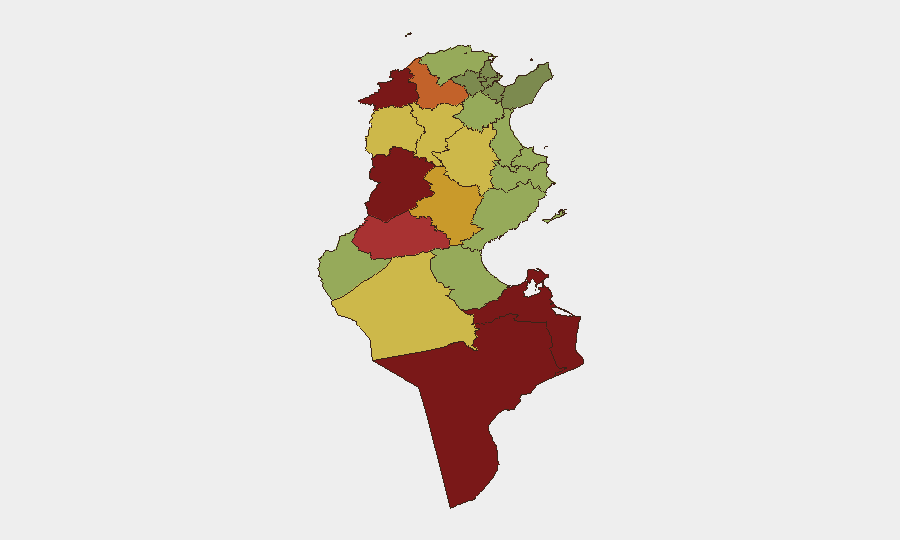
Situation Summary
Tunisia's security environment remains stable at the national level (global rank #76, composite threat score 28), but is marked by mounting civil unrest concentrated in the capital and select interior provinces. The past week saw a spike in pro-Palestinian protest activity, police detentions, and labor-confederation escalation toward a general strike, alongside localized supply-chain concerns tied to fuel-transport action. While no major terror attacks or large-scale violence occurred, the combination of political dissent, judicial decisions sustaining activism, and economic grievances is sustaining disruption risk in urban centers—particularly Tunis—through late September and into October.
Key Developments
- Tunis – 20 September 2026 – Hundreds of demonstrators marched in central Tunis from the National Syndicate of Tunisian Journalists toward Habib Bourguiba Avenue, demanding the release of four Global Sumud Flotilla activists detained on money laundering charges. Participants carried Tunisian and Palestinian flags and accused authorities of criminalizing solidarity activism, indicating elevated political tension and risk of further downtown disruptions.[1][5][9][10][14]
- Tunis – 20–21 September 2026 – Security forces detained at least 11 protesters (some sources cite 13) during and immediately after the 20 September pro-Palestinian march, reflecting a firm policing posture against civil-society actors and creating legal follow-up risk for organizers.[8][10][14]
- Tunis – 20–21 September 2026 – A Tunis court extended pre-trial detention of the four Global Sumud Flotilla activists by an additional four months, catalyzing the weekend protest and signaling continued politicization of the case, which may sustain protest momentum.[1][5][9][10]
- Nationwide – 17–18 September 2026 – Multi-province protests against President Kais Saied's policies and deteriorating living conditions (electricity, water, medicine shortages) originated in Sidi Bouzid and spread to other areas, including demonstrations outside the Ministry of Justice in Tunis, reflecting broad socio-economic grievances.[2][7]
- Nationwide – 9–17 September 2026 (announcement escalated during this week) – Tunisia's main labor confederation (UGTT) announced an escalation plan toward a general strike, accusing the government of worsening economic crisis and shutting down dialogue, implying mounting industrial-relations tension and risk of nationwide work stoppages.[6]
- Nationwide – 23–24 September 2026 (strike announced 19 September) – UGTT petroleum and chemicals federation confirmed a strike by fuel transport workers demanding CNSS enrollment and implementation of a 2019 agreement. Fuel queues reappeared at petrol stations by Friday 19 September, signaling early supply concerns and potential transport disruption if negotiations fail.[13]
- Tunis – Mid–late September 2026 – African migrants protested in the capital demanding repatriation due to harsh living conditions and hostile environment, signaling ongoing tension around migration management and potential for intermittent demonstration activity near international organization offices.[15]
- Tunis – 18–21 September 2026 – INTERPOL Operation Phoenix resulted in 48 arrests across five countries including Tunisia during a three-week border security operation; a separate INTERPOL-wanted murderer was arrested at an Algeria-Tunisia land border on 16 September, underscoring cross-border law enforcement activity.[Note: events occurred 16–18 Sep, reported within weekly window]
Highest-Risk Areas
Kasserine (92), Jendouba (88), and Tataouine (85) drive sub-national risk primarily through civil unrest, economic marginalization, and proximity to ungoverned border zones. Médenine (83) and Gafsa (78) similarly reflect interior-province grievances over living conditions and resource scarcity. The capital, Tunis, is not ranked highest sub-nationally but has emerged as the focal point for political protest and police response this week; corporate personnel and supply chains in Tunis face near-term disruption risk from strikes and demonstrations, while travel to interior provinces warrants heightened caution given economic desperation and limited state services.
How GeoBit Would Assist
Security teams should deploy AOI Monitoring & Early Warning on Tunis downtown (Habib Bourguiba Avenue, Ministry of Justice) and fuel distribution hubs to track protest and strike escalation in real time. Intel Sweep (social media OSINT, Telegram, multi-language search) and Sentiment & Temporal Analysis would flag emerging protest calls and UGTT communications days in advance. Routing & Network Analysis can identify alternative transport corridors and refueling points to mitigate fuel-strike impact on personnel movement.
7-Day Outlook
The fuel-transport strike on 23–24 September is likely to proceed absent last-minute negotiation, causing localized supply disruption and travel delays through late September. Pro-Palestinian protest momentum may sustain if court hearings on detained activists are delayed, with Tunis downtown remaining flashpoint for demonstration activity. Labor escalation toward a general strike remains on track for early October; security teams should prepare contingency plans for administrative delays, transport disruption, and limited access to banking and government services nationwide.
Highest-Risk Areas — Ranked
| # | State / Region | Risk |
|---|---|---|
| 1 | Kasserine | 92 |
| 2 | Jendouba | 88 |
| 3 | Tataouine | 85 |
| 4 | Médenine | 83 |
| 5 | Gafsa | 78 |
| 6 | Béja | 75 |
| 7 | Sidi Bouzid | 72 |
| 8 | Al Kaf | 70 |
| 9 | Kébili | 68 |
| 10 | Kairouan | 65 |
| 11 | Siliana | 62 |
| 12 | Tozeur | 58 |
Sources
Previous Weekly Briefs
A new Tunisia brief is written every Monday, covering the week — each with its own risk map and downloadable CSV. Use the calendar to go further back.
- September 15, 2026
- September 8, 2026
- September 2, 2026
- August 31, 2026
- August 29, 2026
- August 27, 2026
- August 25, 2026
📅 Browse past briefs by calendar →
Highlighted days have a brief. Tap a day for that day's map & analysis, or “csv” for that day's dataset ($5).
Atlas — our AI intelligence desk — emails them this snapshot personally. Nothing else, no list.