Situation Summary
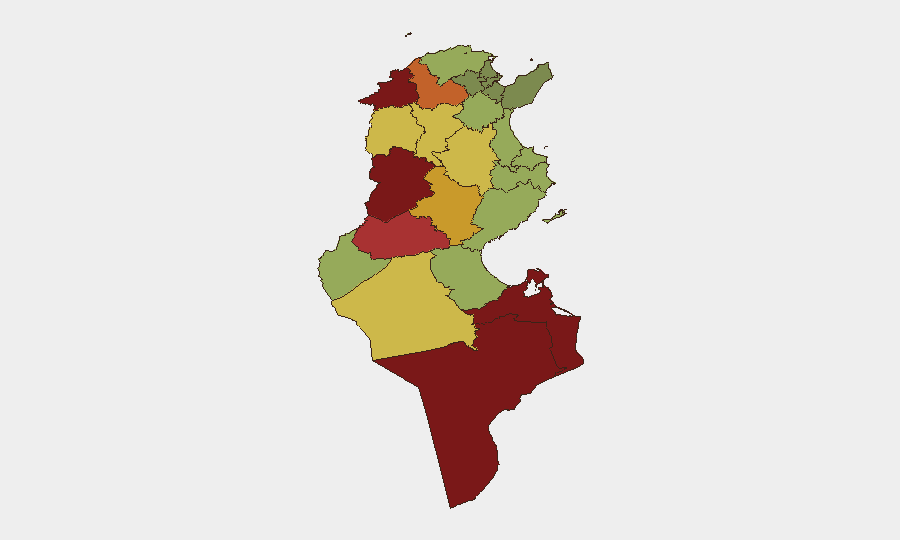
Tunisia's security profile remains stable at the national level (global rank #76, composite threat 28), with civil unrest as the primary driver. However, economic pressures—fuel shortages, electricity and water outages, rising prices, and medicine scarcity—continue to fuel labor action and public discontent. The past week saw a 48-hour fuel-transport strike and journalist detentions, signaling fragility in labor relations and press freedom. Risk concentrations persist in the western and southern border regions, where Kasserine, Jendouba, and Tataouine remain significantly elevated.
Key Developments
- Tunis, September 23–24: Fuel-transport workers launched a 48-hour strike over unpaid wages, working conditions, allowances, and social-security coverage. Action generated petrol-station queues and threatened fuel-distribution disruptions nationwide; supplier Agil reported supplies remained available, but the strike underscored labor fragility and supply-chain vulnerability.
- Nationwide, September 23–24: The fuel strike coincided with public anger over chronic electricity and water outages, rising costs of living, and medicine shortages. Reporting indicates these are ongoing conditions rather than a discrete new crisis, but their convergence with labor action heightens economic and political-stability risk.
- Tunis, September 24: Three journalists from independent outlet Nawaat were detained by Tunisian security forces and reportedly subjected to alleged mistreatment, including deceptive questioning, unauthorized phone access, and threats. The Committee to Protect Journalists called for accountability, signaling renewed concern over press freedom and rule-of-law enforcement.
- Tunisian ports, September 23: Russian vessels operating under flags of convenience were reported to have increased presence in Tunisian ports. Available reporting does not identify specific vessels, port locations, or a confirmed security incident; assess as a maritime-security development reflecting geopolitical positioning rather than an acute disruption.
Highest-Risk Areas
Kasserine (risk 92), Jendouba (88), and Tataouine (85) form a high-risk arc spanning western and southern border regions. These areas have historically concentrated militant activity, smuggling networks, and security-force operations; elevated sub-national scores reflect persistent structural vulnerabilities—marginalization, porous borders, and limited state capacity—rather than this week's labor and press incidents. Gafsa (78), Béja (75), and Sidi Bouzid (72) extend risk into central-western zones. The concentration of risk in periphery regions, well away from the capital and tourist centers, suggests that corporate and expatriate exposure in Tunis and coastal zones remains comparatively lower, though duty-of-care teams should maintain contingency awareness for supply-chain and staff movements through or near Kasserine and Jendouba.
How GeoBit Would Assist
Security teams would deploy Intel Sweep and multi-language OSINT fusion to track labor actions, supply-chain disruptions, and media reports in near-real time, enabling early warning of strikes or civil unrest before operational impact. AOI Monitoring & Early Warning on Kasserine, Jendouba, and Tataouine would provide persistent surveillance of border-region activity and security incidents. Economic & Trade analysis would contextualize fuel, electricity, and medicine shortages against import/export flows and port activity, supporting business-continuity planning.
7-Day Outlook
Labor unrest is likely to remain episodic rather than escalatory in the near term, driven by economic grievance rather than political ideology. However, continued fuel and utility shortages, combined with rising living costs, create conditions for recurring strikes and public discontent through Q4 2026. Border-region risks remain chronic; no imminent tactical shift is forecast, but duty-of-care teams should maintain heightened alertness for supply-chain delays and security-force operations in the west and south.
Highest-Risk Areas — Ranked
| # | State / Region | Risk |
|---|---|---|
| 1 | Kasserine | 92 |
| 2 | Jendouba | 88 |
| 3 | Tataouine | 85 |
| 4 | Médenine | 83 |
| 5 | Gafsa | 78 |
| 6 | Béja | 75 |
| 7 | Sidi Bouzid | 72 |
| 8 | Al Kaf | 70 |
| 9 | Kébili | 68 |
| 10 | Kairouan | 65 |
| 11 | Siliana | 62 |
| 12 | Tozeur | 58 |
Sources
Previous Weekly Briefs
A new Tunisia brief is written every Monday, covering the week — each with its own risk map and downloadable CSV. Use the calendar to go further back.
- September 22, 2026
- September 15, 2026
- September 8, 2026
- September 2, 2026
- August 31, 2026
- August 29, 2026
- August 27, 2026
📅 Browse past briefs by calendar →
Highlighted days have a brief. Tap a day for that day's map & analysis, or “csv” for that day's dataset ($5).
Atlas — our AI intelligence desk — emails them this snapshot personally. Nothing else, no list.