Situation Summary
Tunisia remains a moderate, stable country globally (#76 threat rank) but exhibits significant internal fragmentation driven by civil unrest, economic grievance, and restricted civic space. The past week saw no major security incidents, but institutional developments signal ongoing tension between press freedom, judicial independence, and executive authority. The country's trajectory remains one of managed but latent political strain rather than acute crisis.
Key Developments
- Tunisia-wide — September 30: President Kais Saied amended the cybercrime law, decriminalizing first-time offences involving dissemination of "false news" and replacing imprisonment with fines; repeat violations retain prison penalties. This revision follows criticism of press restrictions and may indicate marginal policy calibration on expression.
- Tunis — September 30: A coalition of nine unions and civil-society organisations, including the UGTT (primary trade federation), journalists' and lawyers' bodies, announced a national march for October 17 addressing economic conditions, freedom restrictions, and judicial independence. The march had not occurred during the reporting week.
- Tunis — September 30: A court postponed the case of journalist Zied El-Heni, charged in connection with allegations of forming a terrorist group, until October 16. Postponement extends legal uncertainty for a high-profile media figure.
- Radès, Tunis Governorate — September 30: Tunisia–Mali friendly football match cancelled at Hammadi Agrebi Stadium, officially due to injury concerns and FIFA ranking implications; primarily a sporting development with minimal direct security implication.
Note: No verified incidents of violent unrest, armed confrontation, terrorism, major crime, or infrastructure disruption were confirmed during September 30–October 6 within available sources.
Highest-Risk Areas
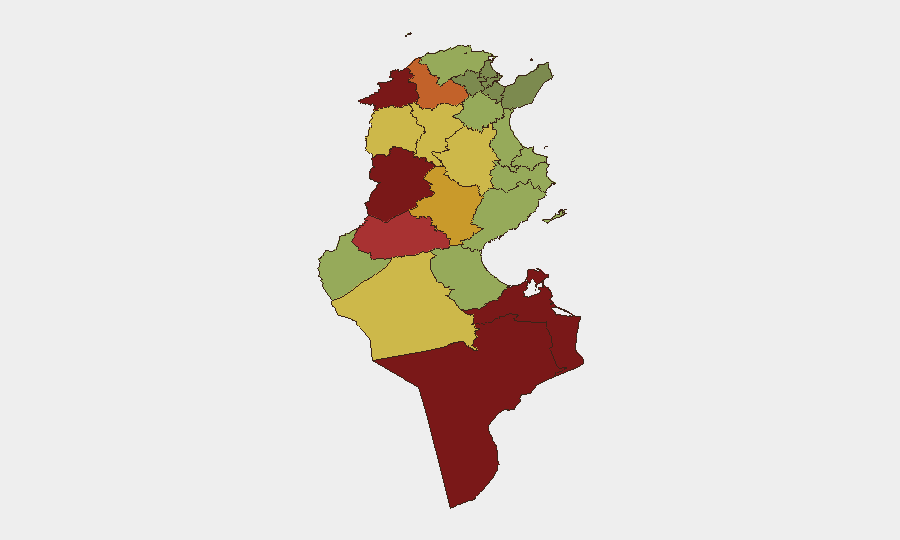
Kasserine (risk 92), Jendouba (88), and Tataouine (85) dominate the sub-national threat profile, reflecting long-standing vulnerabilities in Tunisia's southern and southwestern regions. These governorates face compounding drivers: economic marginalization, weak state presence, proximity to Libya and Algeria (border-security and smuggling exposure), and historical recruitment by extremist networks. Médenine and Gafsa follow closely, sharing similar geographic and socioeconomic characteristics. The central-western and southern belt accounts for the highest concentration of instability; Tunis and coastal northern regions remain comparatively secure.
How GeoBit Would Assist
Security and risk teams monitoring Tunisia should deploy AOI Monitoring & Early Warning on Kasserine, Jendouba, and Tataouine to detect emerging unrest, recruitment signaling, or cross-border movement before escalation. Intel Sweep and multi-language OSINT (including Arabic social media and local radio SIGINT) will capture civic unrest, labor actions, and civil-society mobilization—such as the October 17 march—in real time. Network & Actor Analysis coupled with regime-stability assessment provides visibility into the judiciary–executive friction and press-freedom restrictions that underpin longer-term institutional risk.
7-Day Outlook
The October 17 national march will be a focal point for civil-society activity and police response; attendance and incident reports should be monitored closely for escalation signals. Judicial postponements and marginal cybercrime reform suggest an administration balancing international pressure against domestic control, a posture that typically yields episodic rather than sustained violence. Underlying economic grievance and regional instability in Kasserine–Tataouine remain chronic and are unlikely to resolve in the next reporting cycle.
Highest-Risk Areas — Ranked
| # | State / Region | Risk |
|---|---|---|
| 1 | Kasserine | 92 |
| 2 | Jendouba | 88 |
| 3 | Tataouine | 85 |
| 4 | Médenine | 83 |
| 5 | Gafsa | 78 |
| 6 | Béja | 75 |
| 7 | Sidi Bouzid | 72 |
| 8 | Al Kaf | 70 |
| 9 | Kébili | 68 |
| 10 | Kairouan | 65 |
| 11 | Siliana | 62 |
| 12 | Tozeur | 58 |
Sources
Previous Weekly Briefs
A new Tunisia brief is written every Monday, covering the week — each with its own risk map and downloadable CSV. Use the calendar to go further back.
- September 29, 2026
- September 22, 2026
- September 15, 2026
- September 8, 2026
- September 2, 2026
- August 31, 2026
- August 29, 2026
📅 Browse past briefs by calendar →
Highlighted days have a brief. Tap a day for that day's map & analysis, or “csv” for that day's dataset ($5).
Atlas — our AI intelligence desk — emails them this snapshot personally. Nothing else, no list.